Understand and Respect Tribal Governments and Land
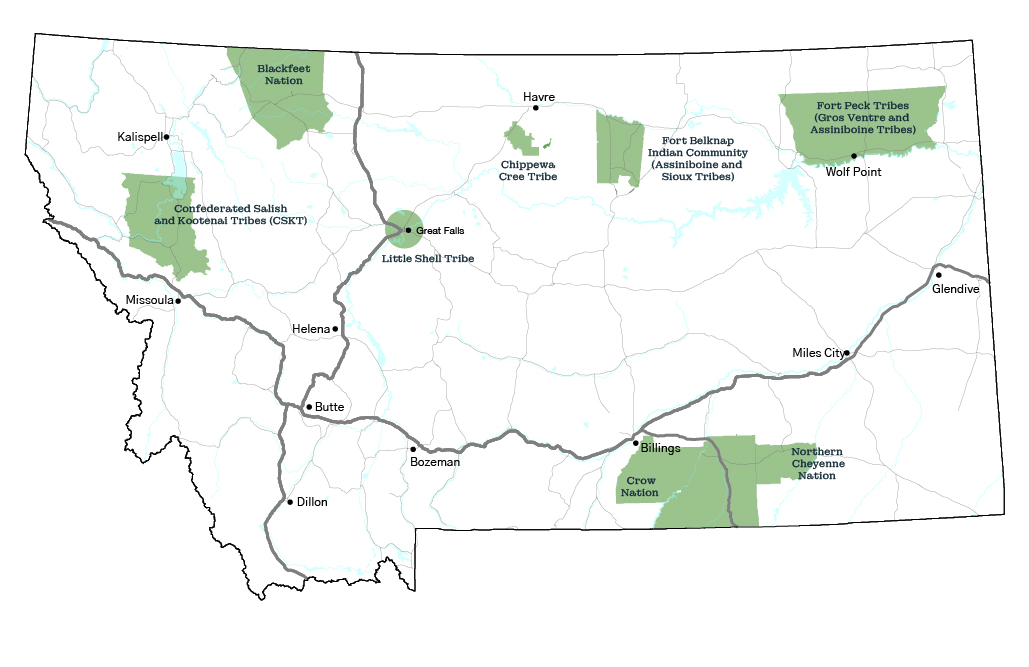
There are eight different Tribal Nations in Montana. They are not counties or municipalities—each is a sovereign government with its own laws, leadership and responsibilities.
The Eight Tribal Nations in Montana
Blackfeet Nation
Confederated Salish and Kootenai Tribes
Crow Nation
Fort Belknap Indian Community (Fort Belknap) – Gros Ventre and Assiniboine Tribes
Fort Peck Tribes – Assiniboine and Sioux Tribes
Northern Cheyenne Nation
Chippewa Cree Tribe
Little Shell Tribe
The Big Picture
Tribal Nations Are Sovereign Governments
Each has its own constitution, laws, courts and elected leaders.
Tribal governments provide services such as education, healthcare, law enforcement and social services.
Tribes maintain nation-to-nation relationships with the U.S. and the State of Montana; tribal citizens are also U.S. and Montana citizens.
Tribes contribute over $1 billion annually to Montana's economy.
Each Tribe Is Distinct
Montana’s Tribal Nations differ in culture, language, governance and history.
Policies for business, access and recreation vary by tribe.
Tribal communities are modern, active governments with diverse economies and services.
Tribal Lands Are Not Public Lands
Reservation boundaries include a mix of tribal, federal, state and private lands.
Access and recreation on tribal lands generally require permission or permits.
Jurisdiction can change within reservation boundaries.
Activities such as hiking, fishing, hunting or camping typically require a tribal permit—contact tribal offices for current regulations and licensed guides.
Do / Don’t
✓ Support tribal-owned businesses when possible.
✓ Learn about local tribal history and current contributions.
✓ Contact tribal offices directly for questions about access or services.
✓ Attend public cultural events and educational opportunities.
X Assume all tribal lands are open for recreation.
X Make assumptions based on stereotypes or movies.